Israeli officials have set the start of Gaza reconstruction on the condition that Hamas fully disarms, pointing to US President Donald Trump's 20-point plan as the guiding framework. The Israeli Prime Minister’s Office said Hamas has not handed over weapons, calling this the main obstacle to rebuilding. This approach matches the U.S.-backed Board of Peace, created under Trump’s Gaza peace framework and supported by U.N. Security Council Resolution 2803 in November 2025. The framework ties reconstruction to Hamas’s disarmament and the handover of governing authority, with plans for a Palestinian technocratic body, the NCAG, to take over civilian administration.
The Prime Minister’s Office said mediators have been asked to push for Hamas’s immediate disarmament across Gaza. The office described Hamas’s refusal to disarm as the key barrier to reconstruction and confirmed that Israel is working with the United States and the Board of Peace to move the plan forward. The Board of Peace said delays in letting supplies in have made a predictable humanitarian crisis worse and have slowed both the disarmament process and the shift of authority from Hamas to a temporary government. The Board called on Israel to allow in materials for temporary housing, water and sanitation, waste management, drainage, and sewage disposal, and also pressed Hamas to follow the peace plan.
Humanitarian Aid and Winter Preparations
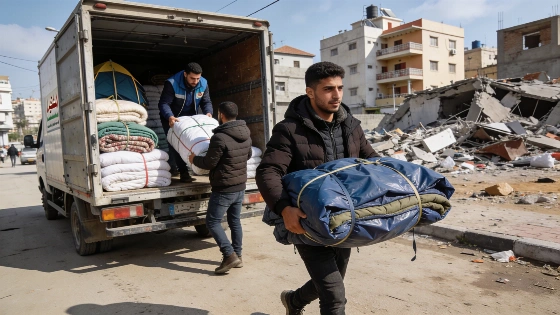
While the disarmament standoff continues, Israel reported that it has allowed more humanitarian supplies to help Gazans get ready for winter. The aid includes over 91,000 tents, more than 8,200 truckloads of tarpaulins, blankets, winter clothing, and other essentials, plus 12 vacuum trucks for sewage removal. The Prime Minister’s Office shared these numbers as part of coordination among COGAT, the Board of Peace, the United Nations, international organizations, and donor countries. A U.N. humanitarian assessment, however, counted over 150,000 tents outside Gaza and ready to enter, with aid efforts limited by Israeli restrictions on supplies and equipment and by funding gaps. The United Nations Humanitarian Coordinator for the Palestinian Territory, Muhannad Hadi Alakbarov, called for the urgent removal of unnecessary restrictions and delays, including those blocking aid groups from bringing in enough vacuum trucks, dewatering pumps, heavy machinery, engine oil, spare parts, tents, tarpaulins, plastic sheeting, blankets, and winter clothing. The U.N. said that flooding and sanitation breakdowns require specialized equipment beyond standard relief packages.
Israeli authorities said humanitarian supplies must not be diverted by Hamas for military use. The Board of Peace recognized Israeli efforts but said they fell short of meeting the emergency, arguing that the amount, speed, and types of materials delivered did not match the scale of the crisis after severe flooding displaced tens of thousands in Gaza. The Board’s comments put humanitarian access and the disarmament timeline in direct political conflict as winter approaches and the proposed shift to temporary governance remains unresolved.
On Tuesday, Israeli Foreign Ministry spokeswoman Michal Maayan accused Hamas of taking humanitarian aid to support its operations and tighten its grip on Gaza. In a video statement posted on X, Maayan called for international actors to hold Hamas responsible and stop further misuse of aid resources.
International Positions and Aid Coordination
The Board of Peace had urged Israel to approve and enable humanitarian supplies into Gaza before winter, noting Israeli actions but calling them insufficient. The Board also said Hamas’s ongoing refusal to disarm has made things harder for Gaza’s civilians. The dispute highlights competing priorities: Israel insists on disarmament before reconstruction, while the Board wants immediate winter relief even as political and security issues remain unsettled.
Israel’s Coordinator of Government Activities in the Territories (COGAT) reported that Gazan merchants had stopped coordinating commercial shipments because of threats and forced taxes by Hamas, not Israeli government restrictions. COGAT said Hamas was demanding about $3,200 per truck and requiring merchants to sell roughly 30% of their goods in cash. Humanitarian aid, though, kept entering Gaza through the United Nations, international organizations, and donor countries. The Board of Peace said that delays in approvals had made a foreseeable humanitarian problem worse and slowed both relief work and the broader transition process.
Disputed Impact and Data Analysis
An analysis from the Australia/Israel & Jewish Affairs Council on 27 October questioned claims of widespread famine and disproportionate civilian casualties in Gaza, using data from the Hamas-run Health Ministry. The analysis cited a natural population growth rate of about 1.2% in 2025 and said males made up 73.4% of registered deaths that year. The data did not specify how many of those killed were combatants. The United Nations-backed famine assessment also used malnutrition and food insecurity data.
As of 10–11 November 2026, Israel continued to say that reconstruction would start only after Hamas fully disarmed, while the Board of Peace kept pushing for faster humanitarian access and also called for Hamas to give up weapons and governing authority. The result is that emergency relief and reconstruction are moving on separate tracks: supplies and sanitation measures are being negotiated or delivered, but permanent rebuilding depends on political decisions. No cited source reported that Hamas had surrendered its weapons by the latest dates covered, so the reconstruction condition remained unmet in the available reporting. For further details, see the BBC News report on the Board of Peace's statement.