
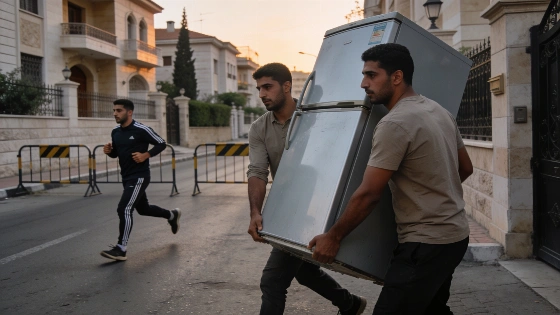
Israeli intelligence officers carried out a covert operation in September 2021, abducting Gen. Abdullah Saberi, a senior commander in Iran’s Islamic Revolutionary Guards Corps, from a diplomatic district in Damascus. Agents disguised as movers bypassed local security and seized the general during his morning jog. Regional sources say the abduction took place in an upscale diplomatic quarter of the Syrian capital, where security checkpoints controlled access. The operatives reportedly hid Saberi in an oversized refrigerator box, restrained and drugged him, then loaded him into a white commercial van to move him out of the area.
Officials in the Middle East, including senior Iranian figures close to Saberi and a Syrian official who reviewed video footage, say the general was restrained, drugged, and transported in a white van. He was then taken to Israel for interrogation. Iranian sources later claimed that after a lengthy interrogation, Saberi was left on a street in Johannesburg, South Africa. There are no confirmed details about his status or whereabouts within the IRGC after that.
Focus on Ron Arad’s Disappearance
The abduction had a clear motive. Israeli interrogators wanted to know what Saberi could reveal about Ron Arad. Arad, an Israeli Air Force navigator, vanished after bailing out over southern Lebanon in October 1986. Israel’s military still lists him as the country’s only service member officially missing in action. The search for Arad became a long-running national-security priority, and in 2008, Israel declared Arad dead. The case has driven later intelligence operations to identify the roles of Lebanese, Iranian, and other regional actors in his fate. Former Mossad POW-and-MIA division chief Rami Igra said Israel "lost the thread" when Arad disappeared, and he has voiced opposition to the view that Arad was taken to Iran.
Over the years, the search for Arad has inspired articles, books, and documentaries. The Israeli government’s determination to resolve the case led to the decision to kidnap a high-ranking Iranian officer decades after Arad’s disappearance. Iranian officials close to Saberi reportedly said Tehran sent him to Lebanon in 2004 to oversee a search for evidence about Arad, during prisoner-exchange discussions. The timeline includes Arad’s disappearance in 1986, the Iranian assignment in 2004, the disappearance of Iran’s former deputy defense minister Ali Reza Asgari in Istanbul in December 2006, and the alleged Saberi abduction in September 2021.
Public and Political Impact
The operation’s impact surfaced at a 2025 protest in Tel Aviv, where supporters of Israeli hostages held by Hamas displayed images of the captives alongside pictures of Ron Arad. The ongoing public attention shows the deep national resonance of Arad’s case and the lengths Israeli authorities have gone to pursue answers. The Saberi allegation was republished by several outlets on November 15, 2026, with most reports relying on the same investigation and preserving details such as the Damascus diplomatic district, the use of movers’ disguises, the refrigerator box, and the white van.
This story draws on information from officials in the Middle East, including Iranian and Syrian sources familiar with the events around General Saberi’s abduction. No regulatory decision, judicial ruling, or official international investigation concerning the alleged Saberi abduction has been identified. The operation remains a subject of regional intelligence reporting and public debate, with the fate of Ron Arad continuing to influence Israeli security policy and intelligence activities. For further background, see the New York Times investigation.