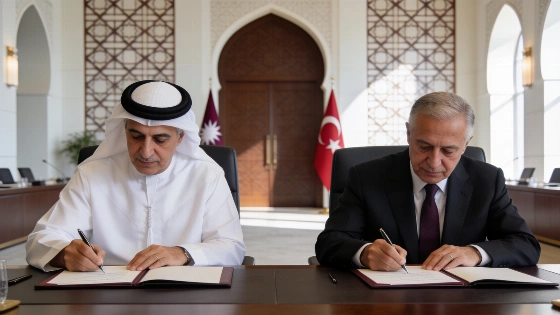
Israeli operations in the Gaza Strip and West Bank have faced sharp criticism from Qatar and Türkiye after the two countries signed a mutual defence agreement. Their joint statement voiced concern that these violations are blocking progress toward a comprehensive resolution of the conflict. The announcement came during the 12th session of the Supreme Strategic Committee between Türkiye and Qatar, held in Istanbul on 13 November 2026 under the leadership of Turkish President Recep Tayyip Erdoğan and Qatari Emir Sheikh Tamim bin Hamad Al Thani.
Commitment to Humanitarian Aid and Reconstruction
Both governments urged Israel to meet its obligations under the ceasefire and international law. They stressed the immediate need to secure safe and unrestricted humanitarian aid delivery across the Gaza Strip. Attacks and threats against aid workers have been rising. The joint communiqué called for full, safe, and unhindered humanitarian access and closer cooperation to expand shelter assistance. The urgency of this work is tied to the first winter flash floods in Gaza, which have made already severe living conditions even worse.
Qatar and Türkiye, as part of their coordinated response, announced an agreement to jointly support Gaza’s reconstruction. The agreement, formalized in the joint communiqué signed on 13 November 2026, set up a bilateral coordination framework covering early recovery and long-term reconstruction, as well as humanitarian aid, shelter, and expanded access for relief operations. The communiqué records a political and diplomatic commitment to coordinate support for Gaza’s early recovery and reconstruction. It does not specify a total budget, project list, implementing agency, procurement schedule, or disbursement timetable. Both sides highlighted the urgent need for action as winter flash floods hit Palestinians in Gaza, worsening already dire living conditions and making them increasingly unbearable. The agreement does not itself announce an operational corridor, delivery mechanism, or enforcement arrangement, but confirms close cooperation to scale up shelter and humanitarian assistance.
A United Nations Satellite Centre (UNOSAT) assessment updated on 13 November 2026 found that 81% of all structures in Gaza had been damaged by June 2026 after more than three years of hostilities. This level of destruction shows the scale of the physical challenge facing any reconstruction program. It points to the need for surveying, controlled demolition, debris clearance, engineering review, and temporary shelter. A joint assessment by the World Bank, United Nations, and European Union published in April 2026 estimated that Gaza’s recovery and reconstruction would require $71.4 billion over the following decade. The Qatar–Türkiye commitment is therefore set within a reconstruction need measured in tens of billions of dollars, not just a narrowly defined humanitarian-relief operation. The available reporting does not show that Qatar and Türkiye pledged the full $71.4 billion or reveal what share of that requirement they plan to support. The conflict’s humanitarian impact has also grown due to the destruction of homes and essential infrastructure, with more than 74,600 people reported killed by 13 November 2026, according to Gaza’s Health Ministry.
Condemnation of Settlement Expansion and Displacement
The joint statement also denounced Israeli settlement activity in the West Bank. It specifically condemned settler violence and land confiscation, as well as the forced displacement of Palestinians, describing these practices as unacceptable and contrary to international law.
The statement said both countries remain committed to supporting the Palestinian people and advancing efforts to rebuild essential infrastructure and restore basic services in Gaza. The communiqué’s focus on shelter and humanitarian assistance directly addresses safety risks identified in UN reporting, which notes that reconstruction planning must account for dangerous structures and not simply replace destroyed housing. The bilateral announcement coincided with a broader Türkiye–Qatar strategic meeting that also covered regional security and the Gaza humanitarian situation, and included the signing of a mutual defence pact between the two countries. More details on the coordination framework and operational mechanisms are expected as the partnership develops. For the full text of the joint communiqué, see the Ministry of Foreign Affairs of the Republic of Türkiye.