
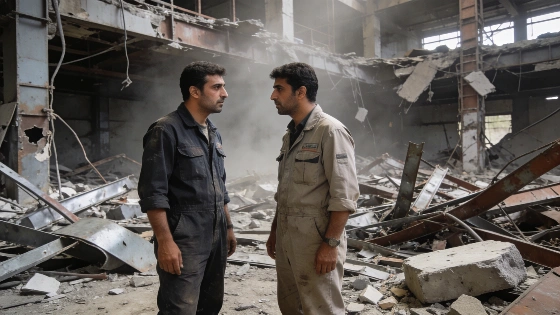
After heavy strikes hit Iranian missile production sites, US officials have tracked a clear slowdown in Tehran's efforts to rebuild its missile infrastructure. The process now leans on components stored before the conflict, which limits how quickly Iran can recover. A Wall Street Journal report from 15 November 2026 cites US intelligence estimating Iran holds between 1,500 and 2,500 missiles after American and Israeli attacks on its military infrastructure. The report points out that Tehran continues to rebuild, but at a slower pace and mostly with parts stockpiled before the strikes. Satellite images reportedly showed collapsed entrances to underground facilities, and Iranian forces later dug out blocked passages to regain access. Despite the damage to production, Iran still has enough capacity to threaten US and allied targets if fighting resumes.
Even with the damage from US and Israeli operations, Iran has managed to restore parts of its missile arsenal. Relying on pre-existing stockpiles has limited both the scale and speed of reconstruction. The Wall Street Journal reported that Iran resumed production in September using finished components stored before the attacks. This approach lets assembly continue even when major plants, access routes, or specialized machinery are damaged, but it cannot match the long-term output of a working industrial base. This bottleneck helps explain why Iran can keep replenishing its arsenal while rebuilding more slowly than before the conflict. According to the Wall Street Journal, Iran still has a significant number of drones and short-range missiles, but the overall missile system rebuild is moving at a slower pace than before the escalation.
Challenges in Assessing Missile Stockpiles
Jim Lamson, a visiting scholar at King's College London and former CIA analyst, described estimating Iran's missile inventory as highly complex. He cited the secrecy of the program, the involvement of multiple producers, and the unknown number of missiles that could be assembled from underground components. Lamson noted that even before the recent conflict, assessments of Iran's missile stockpiles were uncertain. He said, "Having worked in this field within the government, I know that confidence in these estimates can be very low even with all classified information available." Bloomberg reported on 12 November 2026 that Iran was producing about 50 ballistic missiles per month, which is roughly half its prewar production rate. This output relies on existing reserves of missile components, allowing continued assembly despite industrial damage. An assessment published on 12 November 2026 and attributed to an Israeli security source estimated Iran had more than 1,700 ballistic missiles capable of reaching Israel, about 800 fewer than the roughly 2,500 missiles believed available before Operation Roaring Lion began on 28 February 2026. Earlier operations, including Rising Lion in June 2025 and Roaring Lion in February 2026, were said to have damaged Iran’s missile arsenal, production infrastructure, and launcher fleet. The same assessment found signs of limited renewed assembly and production at a lower rate than before the war.
Israeli military officials have estimated Iran holds more than 1,500 ballistic missiles. Regional officials still debate the actual number, given the challenges in getting accurate data. US intelligence estimates, as reported by the Wall Street Journal, put the current stockpile between 1,500 and 2,500 missiles. Independent analysis has also pointed out that damage to Iran’s main missile factories may not be the only obstacle to reconstruction, since smaller facilities making specialized components can create further bottlenecks. Analysts warn that restoring major plants alone would not necessarily bring back the full missile-production chain, and there is no agreement on the timeline for full reconstruction. This reflects uncertainty over underground facilities, dispersed suppliers, and remaining inventories.
Impact of Military and Economic Pressure
A White House official confirmed that "Operation Epic Fury" left Iranian forces incapacitated, and ongoing economic measures have further weakened the regime. A US Embassy statement dated 9 November 2026 described the official American position after Operation Epic Fury, claiming Iran’s weapons production had collapsed. The statement said US forces and partners struck about 90% of Iran’s weapons factories, as well as more than 450 ballistic-missile storage sites and 800 drone-storage sites. US Defense Secretary Pete Hegseth announced that Iran's defense industry base was "finished," and that over 80% of its nuclear industrial base had been destroyed, calling the outcome "by all standards, a historic military victory." Bloomberg reported that Western intelligence estimates put Iran’s missile-production capacity at about 50 ballistic missiles per month, roughly half its prewar capacity, which points to severe but incomplete damage to its manufacturing system. The same reporting noted that Iran’s remaining production depends partly on components gathered before the strikes, limiting its ability to keep up large-scale output.
US officials also said President Trump told his advisors he would not approve further strikes on Iran unless provoked, according to Reuters. In a separate address to the Federalist Society, US Secretary of State Marco Rubio stated that more military operations were unnecessary, as the economic campaign had already severely weakened Iran. Independent reporting shows that, despite the extensive damage and official claims of collapse, Iran still has missiles and some ability to restore production, with existing reserves of missile components letting the regime keep assembling them. There is still no agreement on how long Iran’s reconstruction will take. Israeli officials reportedly believe Iranian rebuilding was moving faster than initial intelligence estimates, partly because of a pause in major strikes and ongoing diplomatic talks with Washington.
For further background, see previous coverage.