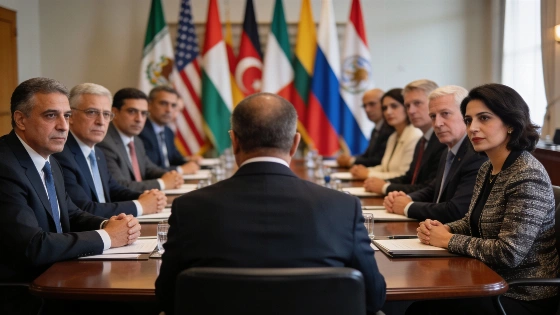
More than $5 billion in international pledges have been committed for Gaza's reconstruction through President Donald Trump's newly formed Board of Peace, according to White House statements. The initiative brings together over 20 countries, including Israel and Qatar, to coordinate funding and recovery for the war-damaged territory. The Board of Peace was created as part of the U.S.-brokered Gaza ceasefire framework set in October 2025. Its mandate covers ceasefire implementation, postwar governance, and reconstruction. The Board operates under a U.S.-led initiative with international backing, following a United Nations Security Council resolution.
The Board of Peace will hold its first meeting in Washington. Member states plan to present a breakdown of their financial contributions and outline the governance structure for managing the pledged funds. White House press secretary Karoline Leavitt said President Trump will chair the board. All member parties are expected to have voting rights on funding decisions. A technocratic layer beneath the main board, made up of representatives from participating countries, will also handle financial oversight. The Board's proposed governance model includes an interim Palestinian administration, the National Committee for the Administration of Gaza. Reconstruction efforts are linked to Hamas disarmament and Israeli military redeployment. Political and security conditions, including disputes over disarmament and access, could delay implementation (Deutsche Welle).
Structure and Participants
Key figures scheduled to address the meeting include President Trump and Secretary of State Marco Rubio. White House special envoy Steve Witkoff, Jared Kushner, former UK Prime Minister Tony Blair, U.S. Ambassador to the United Nations Mike Walz, and Nickolay Mladenov, who will serve as director-general of the board, are also on the agenda. Mladenov previously served as U.N. special coordinator for the Middle East peace process.
The meeting will take place at the Donald J. Trump Institute of Peace. The institute was renamed from the U.S. Institute of Peace after a restructuring that saw most of its board and staff dismissed as part of the Department of Government Efficiency's cost-cutting measures. According to White House statements, the Board of Peace aims to coordinate humanitarian assistance and support the National Committee for the Administration of Gaza. It will also oversee the International Stabilization Force.
Funding, Plans and International Response
Jared Kushner, who played a role in negotiating a ceasefire between Israel and Hamas, has presented a "master plan" for Gaza's redevelopment. The plan envisions hundreds of skyscrapers and a coastal tourism zone, with an estimated investment requirement of at least $25 billion for construction over two to three years. Kushner indicated that the immediate focus will be on delivering humanitarian aid to Gaza in the coming months.
By September 2026, the Board of Peace had moved from broad financial pledges to a defined six-month recovery blueprint valued at $2.45 billion. This initial phase includes 66 projects covering urgent reconstruction and governance needs such as temporary housing and hospital repairs. These projects were described as ready to begin once financing and access are secured. The plan was unveiled at a Board meeting in New York during the U.N. General Assembly (Associated Press).
Despite broad international participation, major European allies of the United States have not joined the Board of Peace. They expressed concerns that the initiative could bypass the United Nations' role in crisis management. The Vatican also declined to participate as an observer, citing unresolved issues and emphasizing the UN's primary responsibility in such situations. White House press secretary Leavitt described the Vatican's decision as "unfortunate," highlighting the board's legitimacy and the diversity of its membership. Reporting shows the United States has pledged $10 billion, but as of September 2026, only about $280 million had been transferred against roughly $17 billion in pledges, with the official Gaza reconstruction fund described as empty. This funding shortfall has been a central constraint on implementation.
Reconstruction needs in Gaza remain substantial. A joint assessment by the United Nations and World Bank in April 2026 estimated that rebuilding the territory could require $71.4 billion over 10 years. Current pledges represent only a fraction of the total requirement. The Board's recovery plan is structured as an initial phase, with further funding and project tranches anticipated as conditions allow.
Governance and Security Conditions
President Trump has called for Hamas to uphold its commitment to full and immediate demilitarisation as a condition for lasting peace and successful reconstruction. A senior U.S. official, cited by ABC News, rejected claims that negotiations over Hamas's disarmament had stalled. Mediators reported encouraging progress despite ongoing challenges. The Board's implementation timetable is conditioned on verified security developments rather than financial pledges alone. Reconstruction is expected to proceed gradually, with a plan announced in July envisioning phased Hamas disarmament and Israeli Defense Forces movement back to the "Yellow Line." Sector-by-sector transfer of authority to an interim Palestinian administration is also planned. This sequencing means that housing and hospital projects may remain delayed even where plans and donor commitments exist.
The Board of Peace's launch follows recent negotiations led by Steve Witkoff and Jared Kushner in Geneva with Iran regarding its nuclear programme, as well as talks with Russian and Ukrainian representatives. President Trump has previously threatened action against Iran if it does not agree to limit its nuclear activities. The first round of U.S.-Iran talks took place in Oman earlier this month.
By November 2026, reporting characterized the Board's Gaza reconstruction effort as stalled despite its original mandate and announced funding. Humanitarian consequences included continued displacement and flooding in tent settlements, with limited progress on permanent or temporary reconstruction. The Board's own recovery plan remained dependent on access, disarmament, Israeli military redeployment, and actual release of donor funds. The contrast between the scale of reported pledges and the much smaller amount transferred illustrates the implementation gap. Board officials had prepared 66 projects and identified at least $280 million for immediate work, but access and security conditions remained unresolved, and the official fund was described as empty. The plan included temporary housing for hundreds of thousands of people, making delivery logistics a material test of the Board's credibility. Later coverage described continued displacement and worsening conditions in tent camps while the wider political process remained blocked.
According to ABC News, the Board of Peace will provide regular updates on its activities, including humanitarian assistance and reconstruction progress in Gaza.