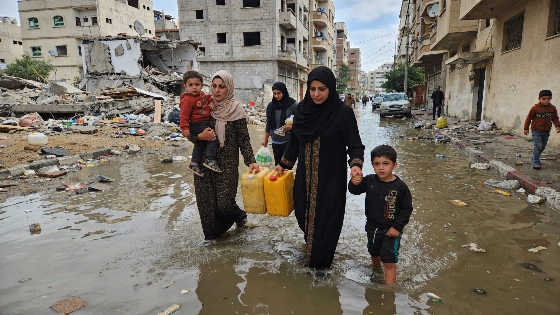
Flooding from heavy rains has pushed Gaza deeper into humanitarian crisis, as civilians struggle with worsening conditions during ongoing conflict. In early November 2026, the United Nations Office for the Coordination of Humanitarian Affairs (OCHA) reported that storms and strong winds hit displacement sites in all five governorates. More than 26,000 households reported damage to shelters or belongings. Over 6,000 family shelters were destroyed and 17,400 damaged, leaving more than 3,900 households without shelter. Water reached up to 1.5 metres in some locations. Humanitarian stocks of tents, tarpaulins, blankets, and clothing inside Gaza were nearly depleted, adding to the emergency (UN News report). At a recent United Nations General Assembly session, Vietnam's Deputy Permanent Representative to the UN, Minister Counsellor Nguyen Hai Luu, raised urgent concerns and called for immediate steps to protect civilians and guarantee safe humanitarian aid delivery.
During the Special Political and Decolonisation Committee's discussion on the United Nations Relief and Works Agency for Palestine Refugees in the Near East (UNRWA), Luu highlighted the agency's vital and unique role in supporting millions of Palestinian refugees across Gaza, the West Bank, Jordan, Lebanon and Syria. The humanitarian situation in Gaza has worsened as infrastructure has been destroyed or damaged. UNICEF reported that the rains affected more than 106,000 people and damaged or destroyed shelters, latrines, and personal belongings. Nearly 1 million displaced people were living in flood-prone areas, including about 400,000 at extremely high risk, almost half of them children. UNICEF estimated that 1.7 million displaced people remained in tents, makeshift shelters, or damaged buildings exposed to flooding, cold, and collapse (UNICEF statement). Luu repeated the call for all parties to maintain the ceasefire, show maximum restraint, and follow international humanitarian law. He also stressed the need to protect humanitarian workers and civilian infrastructure, and to make sure aid reaches those in need without barriers.
UNRWA Mandate and Funding
Vietnam welcomed the extension of UNRWA's mandate until June 2029 and noted ongoing work to strengthen the agency's neutrality, transparency and accountability. The Vietnamese delegation called for adequate, stable and sustainable funding so UNRWA can keep operating. Luu affirmed the importance of respecting the UN Charter, the privileges and immunities of the United Nations, and the obligations set out by the International Court of Justice in its advisory opinion of October 2025.
UN agencies have pointed out that the flooding emergency is part of a broader crisis caused by conflict, displacement, damaged infrastructure, and shortages of shelter and relief supplies. By mid-November 2026, a UN Secretary-General spokesperson estimated that more than 200,000 people may have been affected by the rainfall and needed humanitarian help. Damage reports included more than 40,000 family shelters, over 900 latrines, and nine health facilities. Humanitarian responders had reached about 750 households, or around 4,500 people, while a separate operation to remove floodwater, clear drainage channels, and level ground was expected to reach about 3,700 families. The response was limited by restricted access to much of Gaza, not enough relocation space, and shortages of machinery, fuel, engine oil, and spare parts. No wastewater treatment plant in Gaza was working, and in Gaza City, rainwater mixed with sewage threatened to overflow from the Sheikh Radwan stormwater basin, where only two of six pumps were running. More than 150,000 tents bought by humanitarian partners and member states were outside Gaza waiting for dispatch, including about 117,000 tents held by the Egyptian Relief Committee in El Arish.
Peace and Reconstruction Prospects
On the outlook for peace and reconstruction in Gaza, Vietnam referenced UN Security Council Resolution 2803 (2025) and the Gaza peace plan as ways to support the ceasefire and move recovery efforts forward. Luu said that Vietnam, as a founding member of the Board of Peace, is ready to work with international partners to help achieve lasting peace and recovery in Gaza, in line with the UN Charter and international law. The Vietnamese representative stressed that humanitarian aid cannot replace a fair and lasting political solution, and called for an end to actions that change the status and demographic makeup of the Occupied Palestinian Territory. Vietnam also urged that the legitimate rights of Palestinian refugees, including property and compensation issues, be addressed.
Vietnam repeated its steady support for the Palestinian people's right to self-determination and the creation of an independent and sovereign State of Palestine, based on pre-1967 borders with East Jerusalem as its capital, living peacefully alongside Israel. During the committee discussion, many countries reaffirmed UNRWA's essential role and called for more financial support, while Israel continued to oppose the agency's operations. According to the original report, the Fourth Committee is expected to consider and adopt relevant draft resolutions on November 18, 2026.
UN humanitarian partners reported that after the storms, they had provided tents, tarpaulins, blankets, and other supplies to about 1,800 families, which is only about one-third of the estimated 5,200 families whose immediate needs had been assessed. Response teams had removed standing water, dug drainage channels, and cleaned affected areas, but the rainy season was expected to last for several more months. The UN warned that contaminated standing water, damaged sanitation networks, and not enough pumps, sandbags, and equipment raised the risk of disease and prolonged displacement. Humanitarian organizations identified access restrictions, approval requirements, and limited crossing capacity as practical barriers to delivering shelter, sanitation, and flood-response equipment at the scale needed.
This report is based on information provided by the Vietnam News Agency and United Nations sources.