
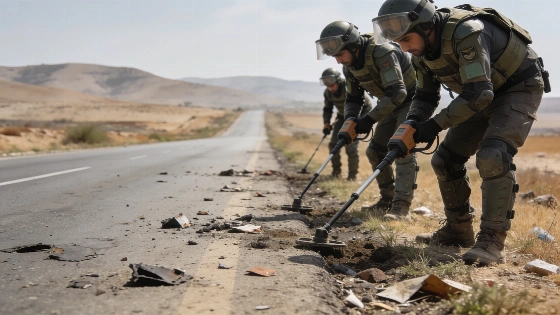
Specialised mine-action teams have started work along the Damascus–Deir Ezzor highway, aiming to find and clear explosive hazards before reconstruction or expansion can move forward. The operation covers both sides of the 440-kilometre route, which serves as a key transport corridor in Syria. The scale of explosive-ordnance contamination remains high: more than 14.3 million Syrians face risks from explosive ordnance, according to the 2026 Humanitarian Needs Response Plan (UNOPS). Between December 2024 and June 2026, 2,335 civilian casualties were recorded nationwide from explosive hazards. These figures show why comprehensive surveys and risk mapping are needed before any roadworks begin.
Minister of Emergency and Disaster Management Raed al-Saleh stated that clearance teams from his ministry are working with engineering units from the Ministry of Defense to carry out the survey. After all landmines and unexploded ordnance are removed, the highway will be handed over to the General Establishment for Road Transportation under the Ministry of Transport. This transfer will allow rehabilitation and expansion works to start safely. The Syrian National Mine Action Centre, which operates under the Ministry of Emergency and Disaster Management, is responsible for mine and unexploded-ordnance clearance. Its duties include clearing explosive hazards, building national technical capacity, and developing standards for mine-action work.
Operational priorities and national mine action
Minister al-Saleh stressed that making the land safe is a necessary step before any infrastructure rehabilitation. He also pointed out that the survey operation has been organised to avoid interfering with ongoing emergency response activities in other provinces. Personnel from several provinces have been assigned to the highway project under an operational plan that keeps teams ready and able to serve in their original areas of responsibility.
The challenge remains substantial. UNICEF-related data shows that between 8 December 2024 and 28 February 2026, Syria saw about 1,051 explosive-ordnance incidents, resulting in 1,891 casualties, including 698 deaths and 1,193 injuries. An estimated 324,000 landmines and explosive remnants of war are still present in the country, and roughly five million children are exposed to these dangers. The Deir Ezzor region has seen incidents in abandoned military positions and in grazing and livelihood areas. Save the Children reported four children killed by explosive remnants in less than one week in November 2026 (ReliefWeb). On 2 November 2026, incidents in a grazing area in Deir Ezzor killed one child and one adult and injured another child and adult. These events show the ongoing risk to civilians and the agricultural sector.
The National Mine Action Center faces further obstacles due to shortages of specialised personnel and equipment, along with limited financial resources. The United Nations Mine Action Service estimated that its 2025 Syria appeal needed $67.2 million for planned activities, but the sector remains critically underfunded. This funding gap affects survey capacity, protective equipment, marking systems, clearance machinery, technical training, and survivor assistance. All of these are necessary for the safe rehabilitation of major infrastructure like the Damascus–Deir Ezzor highway.
International cooperation and ongoing challenges
On 20 September, Syria’s Ministry of Emergency and Disaster Management and Ukraine’s Ministry of Economy and Environment signed a high-level cooperation agreement focused on humanitarian mine action. The agreement aims to use Ukrainian expertise in mine clearance, technical surveys and technological assessments, especially in agricultural areas affected by explosive hazards.
Clearance operations are also underway on roads and populated land in other regions, such as the countryside of Tal Tamr, Hasakah. Military engineering teams spent nearly four months clearing mines and improvised explosive devices before moving to the Bab al-Faraj area. These efforts aim to make agricultural and residential areas safe and support the return of displaced families before the new agricultural season. This approach reflects a broader national strategy to prioritise civilian safety and the return of displaced people, then address agricultural land and reconstruction-related clearance.
Mine clearance in eastern Syria continues to bring operational risks for personnel. In the al-Mayadin area of eastern Deir Ezzor countryside, a Syrian soldier was killed and another seriously injured during an operation to dismantle munitions. This incident highlights the dangers faced by engineering and demining teams. The Deir Ezzor region’s contamination also affects transport links, agricultural land, irrigation systems, and oil and gas infrastructure. These factors increase the cost and risk of repairing infrastructure and allowing displaced residents to return.
The Syrian Arab News Agency (SANA) reports that the clearance and survey of the Damascus–Deir Ezzor highway is a key step in restoring safe transport links and enabling broader reconstruction efforts in the region. The sequence of mine clearance, road rehabilitation, and the return of displaced populations remains central to Syria’s recovery and the restoration of essential services along this strategic corridor.