
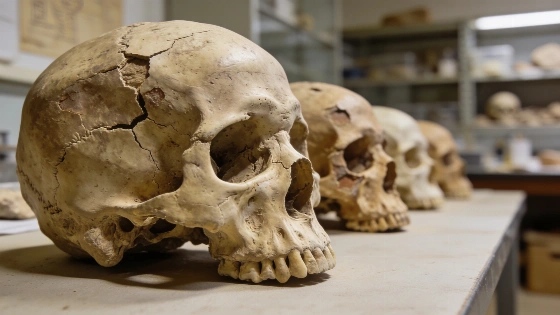
Researchers have uncovered deliberate, likely fatal head injuries in almost 40 percent of skulls from Egypt's earliest royal burial grounds at Abydos. Their work, published in Frontiers in Environmental Archaeology and covered by ScienceDaily, gives the most direct physical backing yet for the long-standing theory that royal attendants were killed to serve their rulers after death. Dr. Roselyn A. Campbell of Purdue University led the study, focusing on remains from subsidiary burials at the First Dynasty royal cemetery at Umm el-Qaab, Abydos, dating to around 3000 BCE. The skulls examined belong to the Duckworth Collection at the University of Cambridge, originally excavated by Flinders Petrie.
The research examined 46 skulls from the Duckworth Collection at Cambridge University, which Flinders Petrie excavated in the 1920s. Dr. Roselyn Campbell led the new analysis, applying modern forensic methods to remains Petrie had set aside. She identified 18 skulls with significant cranial trauma, mainly linear fractures, and sharp-force injuries such as a chopping wound to one individual's eye. These wounds match perimortem trauma—damage inflicted at or near the time of death—rather than harm from burial or later excavation. Campbell stated that "the injuries on the preserved crania are generally linear fractures, which would likely cause rapid unconsciousness, internal bleeding, and death." Most trauma appeared as linear fractures across the cranial vault, with sharp-force injuries making up a smaller part of the evidence.
Revisiting a Century-Old Archaeological Debate
Petrie noticed that tombs of First Dynasty kings, dating back about 5,000 years to around 3000 BCE, were surrounded by rows of subsidiary graves. He suspected those buried nearby had been sacrificed, but lacked clear proof of violent death. Most remains were reburied, but some skulls were preserved and later sent to the UK. Campbell's analysis now delivers the first direct physical evidence supporting Petrie's idea. The research revisited preserved remains from the original digs and used modern forensic distinctions between injuries near death and damage from burial, environmental factors, or excavation. The study found that 18 of the 46 skulls—about 39 percent—showed major cranial trauma, but this percentage applies only to the preserved sample, not the entire population buried at Abydos.
Campbell reported that the injuries found would likely have caused rapid unconsciousness, internal bleeding and death. The study estimates that at least 39 percent of those examined may have been deliberately killed, though this is a minimum figure. The evidence points to retainer sacrifice—a practice where members of the royal household or lower- to mid-level officials and artisans were killed to accompany the king—as part of burial customs for Egypt's earliest rulers. Campbell described retainer sacrifice as a form of human sacrifice where those close to a ruler are killed when the ruler dies, and the subsidiary graves at Abydos are spatially linked to royal funerary complexes from the start of Egyptian state formation. Still, the findings do not prove that every injured person was intentionally sacrificed or clarify the exact cause of death in each case.
Who Were the Buried Attendants?
Each subsidiary grave at Abydos was a simple chamber, sometimes with a coffin and a few grave goods such as ceramic vessels, copper tools, projectile points or small ivory figurines. Some graves had markers with names and official titles, showing that those buried were not nameless servants but people with defined roles in the royal household. Campbell explained that retainer sacrifice could reflect a belief in continued service to the ruler in the afterlife or act as a display of royal power. The study notes that while some retainers might have volunteered, others may have been chosen or forced. The research points out that individuals buried around royalty are often overlooked in the broader story, despite their importance in early Egyptian state formation.
Limits of the Evidence and Next Steps
While the injuries offer strong evidence for violent deaths among some buried near the kings, the exact circumstances remain unclear. The research is based on the 46 skulls that survive, not the full group of those interred at Abydos. It is not possible to tell from the available evidence whether any individual volunteered or was forced to die. The findings suggest that at least some people may have been deliberately killed, but they do not show how every person buried beside the rulers died. Campbell's upcoming book, State-sanctioned Violence and Human Sacrifice in Early Dynastic Egypt, will be published by Routledge Press and will examine these findings further.
This study draws new attention to the people buried alongside Egypt's founding kings, shifting the focus from rulers to those whose lives and deaths were tied to royal power. ScienceDaily reported the research on behalf of Frontiers in Environmental Archaeology. More details on the forensic analysis and its impact on understanding early Egyptian burial practices are available in the ScienceDaily summary.