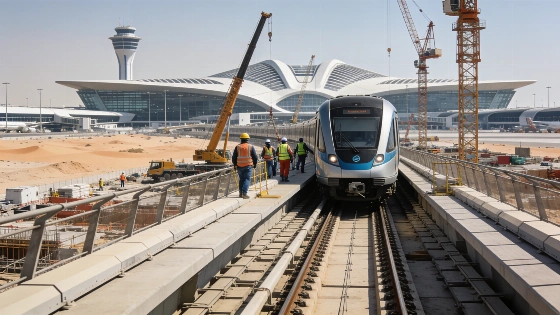
Dubai’s leadership has signed off on a new Metro extension, paving the way for a direct rail link to Al Maktoum International Airport City. The AED 2 billion project, set for completion in 2031, will add two stations and stretch Route 2020 by three kilometres, giving direct access to the airport’s West Terminal. The National reports the project cost at about $544.6 million. This extension is part of a larger group of strategic schemes worth over AED 11 billion, all approved by Dubai’s Executive Council. Dubai’s Roads and Transport Authority (RTA) and the Dubai Engineering Projects Establishment will deliver the extension together. The plan calls for a direct connection to the airport’s West Terminal, not just the surrounding area. The National
His Highness Sheikh Hamdan bin Mohammed bin Rashid Al Maktoum, Crown Prince of Dubai, Deputy Prime Minister and Minister of Defence of the UAE, and Chairman of The Executive Council of Dubai, gave the green light during the UAE Annual Government Meetings 2026. The extension is planned to link up with the airport express line and Etihad Rail’s high-speed railway, creating a transport interchange for passengers and airport staff. MEED notes the extension will run from the Expo 2020 terminus toward Al Maktoum International Airport City, with passenger services expected to start in 2031. MEED
Strategic Infrastructure and Urban Mobility
Dubai’s Roads and Transport Authority (RTA) and the Dubai Engineering Projects Establishment will handle the Metro extension together, with operations planned for 2031. The project backs Dubai’s goal to turn Al Maktoum International Airport into the world’s largest aviation hub and aims to keep transport infrastructure in step with the city’s fast growth. The extension is set to link Dubai Metro with the airport express line and Etihad Rail’s high-speed network, building a multimodal interchange at Al Maktoum International Airport City. EnterpriseAM points out this Metro extension is separate from the proposed Airport Express Line between Dubai International Airport and Al Maktoum International Airport. The first phase of commercial operations at the expanded Al Maktoum airport is scheduled for 2032, while Metro services are targeted for 2031.
Connecting the airport directly to Dubai’s residential and business districts, the extension is expected to boost accessibility and cut reliance on private cars. Tying in with Etihad Rail’s high-speed network will further improve links across the emirate. The finished route should give direct access to the airport’s West Terminal and better connections for passengers, airport employees and visitors. The project remains at the approved planning stage, with no tender, main contractor, or construction start date announced so far.
Sheikh Hamdan called Al Maktoum International Airport City one of Dubai’s most important strategic projects, saying: “Al Maktoum International Airport City is one of our most significant strategic projects, reinforcing Dubai’s position as a global aviation hub. The extension is part of an integrated transport system that matches the ambitions of this global project.” He added, “We continue to invest in infrastructure that anticipates future aspirations, connects the emirate and strengthens Dubai’s competitiveness.”
Broader Development Programme and Real Estate Expansion
The Metro extension is part of a wider AED 11 billion infrastructure and community development programme approved by The Executive Council of Dubai. This includes an AED 9.59 billion plan to expand public services and community facilities through 2040, focusing on integrated, sustainable neighbourhoods and residential communities for Emirati citizens. Planned projects will bring healthcare centres, educational facilities, sports infrastructure, public parks and essential services to support Dubai’s growing population.
The Executive Council has also backed a Dubai Land Department study forecasting about 365,000 new residential units and 1.1 million square metres of office and retail space by 2030. The study shows high occupancy rates: 97% for residential properties, 98% for retail spaces and 94% for offices. These numbers fit with the Dubai Real Estate Sector Strategy 2033, which aims to double the sector’s GDP contribution to AED 73 billion, lift transaction volumes by 70% and push the total value of real estate transactions to AED 1 trillion.
The strategy also aims to double real estate portfolio value to AED 20 billion, strengthening Dubai’s standing as a top international property investment destination.
Investment Policy and Long-Term Vision
The Executive Council has approved a new policy for endowments and minors’ funds managed by Awqaf Dubai, with endowment assets valued at AED 13.5 billion in 2025. The policy seeks to diversify investment portfolios and boost financial sustainability, targeting an extra AED 10 billion in real estate portfolio value and more than 35% growth in securities investments by 2030.
These moves show Dubai’s integrated approach to development, combining transport connectivity, urban expansion, investment diversification and community well-being. As Al Maktoum International Airport moves forward with its transformation, the Metro extension is positioned to link major infrastructure projects with the needs of residents and international visitors.