
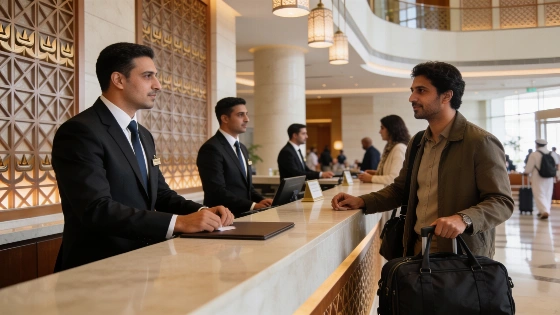
Operators in Dubai’s hotel sector have seen occupancy rates climb since May, with Rotana Hotel Management Corporation posting figures between 75 and 80 per cent. Citywide data from the Dubai Department of Economy and Tourism (DET) shows overall market occupancy moving from 36% in March to 66% in August 2026. That jump signals a strong, though still partial, rebound. The 66% August occupancy reached 89% of the August 2025 level, so demand has picked up but hasn’t fully returned to normal. In the first eight months of 2026, Dubai welcomed 6.97 million international overnight visitors, including about 869,000 in August. Hotel inventory neared 149,000 rooms by the end of August, and properties logged 21.61 million occupied room nights in that period. DET’s available data does not independently confirm Rotana’s 75–80% occupancy range, which appears to reflect its own portfolio rather than the entire Dubai market. These figures are outlined in the Dubai Tourism Statistics 2026.
Haitham Mattar, managing director for the Middle East, Africa and South-west Asia at IHG Hotels & Resorts, said the year started strong before a sharp drop in April. By July, the downturn had eased. Key source markets like India, China, Russia and the UK began to recover. Mattar pointed out that domestic and regional guests have played a key role for both leisure and business travel, while international group travel from Russia has not yet reached previous levels. DET data shows Western Europe and South Asia led international overnight stays from January to August 2026, supporting a more varied source-market structure for Dubai’s hospitality sector.
Market Adaptation and Diversification
Eddy Tannous, chief operating officer at Rotana, observed that hotels previously dependent on international leisure guests faced tougher conditions during the downturn. Many properties have since shifted their business mix to match changing demand. The Department of Economy and Tourism’s A Dubai Invite initiative encouraged residents to invite family and friends to visit, offering hotel discounts and resort credits at participating properties until October 31, 2026. This programme helped boost forward bookings, especially as UK travel restrictions for the UAE eased and Russian travellers started returning, particularly couples and families.
India and China continue as important tourism source markets for Dubai, with new demand coming from Spain and Italy. This change signals a broader source-market mix for the city, which had previously leaned more on Germany, Russia and the UK, according to Tannous. The mix of rising arrivals and lower-than-normal occupancy also shows the effect of expanded room supply and weaker room utilisation on headline hotel performance.
Development Pipeline and Investment
Despite earlier disruption, hotel groups are sticking with their development plans across the region. IHG has 65 hotels in the pipeline in Saudi Arabia, 18 new hotels planned in the UAE over the next three to five years, and 28 properties in Egypt. Mattar linked this ongoing investment to the long-term outlook of hospitality investors and cooperation between tourism authorities and the private sector.
Accor, another major operator, currently runs 380 hotels in the Middle East and has 190 more in its pipeline. Saudi Arabia, the UAE and Egypt remain its main growth markets, with more signings in Lebanon and other regional locations. Duncan O’Rourke, CEO for the Middle East, Africa and Asia-Pacific at Accor, said business started coming back from August. He expects the UAE to see a quick recovery, with the fourth quarter of 2026 and first quarter of 2027 likely to be important for the sector. Dubai entered 2026 after posting a third straight annual record for international overnight visitors, with 19.59 million visitors in 2025—a 5% year-on-year increase. The emirate’s full-year 2025 hotel occupancy averaged 80.7%, with an average daily rate of AED579 and revenue per available room at AED467, giving a strong pre-disruption benchmark for assessing the 2026 downturn. Dubai International airport handled 95.2 million passengers in 2025, reinforcing the city’s role as a major aviation and stopover hub, as reported by the Government of Dubai Media Office.
Expanding Hospitality Offerings
Investment in infrastructure and accommodation is widening the region’s appeal beyond luxury travel. Tarik Fadil, vice president of supply at Agoda, noted that a broader range of accommodation, activities and experiences is drawing more Asian travellers, with India, China, South Korea, Indonesia and Malaysia gaining as source markets. Luxury hospitality continues to attract investment, especially in Saudi Arabia and the UAE. IHG has brought its Regent brand to the region, with three properties planned in Saudi Arabia and two in the UAE. Six Senses has also grown its presence with a property at The Palm, Dubai, set to open in November 2026.
Mattar stressed that opportunities extend beyond luxury, as domestic and regional travellers increasingly look for experiences and value. While the sector’s outlook is improving, executives remain careful about calling a full recovery. Mattar said it is still hard to set a timeline for a complete rebound, and Agoda has not forecast when the region will return to 2025 levels. Dubai’s hotel market recovery has been broad but uneven across segments, with value-focused accommodation such as Emaar’s Rove brand recording 72% occupancy during the downturn, compared to 63% for Emaar’s wider UAE hotel portfolio. Mohamed Alabbar, founder of Emaar, was reported as expecting occupancy across the company’s Dubai hotels to move toward normal levels within 12 months. The supply-demand balance, with hotel inventory close to 149,000 rooms by August 2026, continues to shape occupancy rates and pricing power across the sector.